
How Does ChatGPT Decide Which Businesses to Recommend?

Table of contents
- What search engine does ChatGPT use to find businesses?
- OpenAI's shopping page describes product selection, not local ranking
- Yelp's shareholder letters document a paid local data input
- Google's guide and Business Profile pages describe a different source system
- Perplexity's research post separates its index from partner data
- The published source map shows different inputs for each assistant
- Can a business pay to be recommended in ChatGPT?
- What nobody has published
ChatGPT's business recommendations are more complicated than a count of mentions across the web or a single search engine. How does ChatGPT decide which businesses to recommend? When it searches with partners, it typically rewrites the question into targeted searches and can draw on partner data, including Yelp ratings and reviews in relevant categories. OpenAI says its search ranking uses “multiple factors” and that “Placement is not guaranteed.” It does not publish the weights.
A citation is a page used as a source; a recommendation is a business named in the answer. A platform can supply the former while a business listed on that platform receives the latter.
What search engine does ChatGPT use to find businesses?
OpenAI does not name a search provider in the text of its ChatGPT search help page. The page says ChatGPT search sometimes partners with other search providers and links the Microsoft and Shopify privacy policies under information about how search providers may process queries.
The page does not say which provider handles a particular search or what share of searches goes to either company. It also describes an OpenAI search crawler and local information from trusted third parties. Calling every business recommendation a result from one search engine goes beyond what the document says.
OpenAI gives an example of the query transformation. A person asks for good restaurants “near me”; if ChatGPT determines from the person's IP address that they are in the San Francisco area, the search may become “top restaurants San Francisco.” The IP address itself and ChatGPT account information are not shared with third-party search providers, according to OpenAI.
Memory can change the search too. OpenAI says that if a person has shared that they are vegan and live in San Francisco, ChatGPT may search for “good vegan restaurants San Francisco” when asked for nearby restaurants. Sharing more precise device location is optional and off by default; when enabled, it can supply more specific location information for nearby business answers.
A hypothetical rewrite shows what changes for a business. Say ChatGPT has a saved memory that a user is vegan and determines from the user's IP address that they are in San Francisco. If the user asks for a nearby restaurant, the search could contain “good vegan restaurants San Francisco,” even though the person did not type either “vegan” or the city in that question.
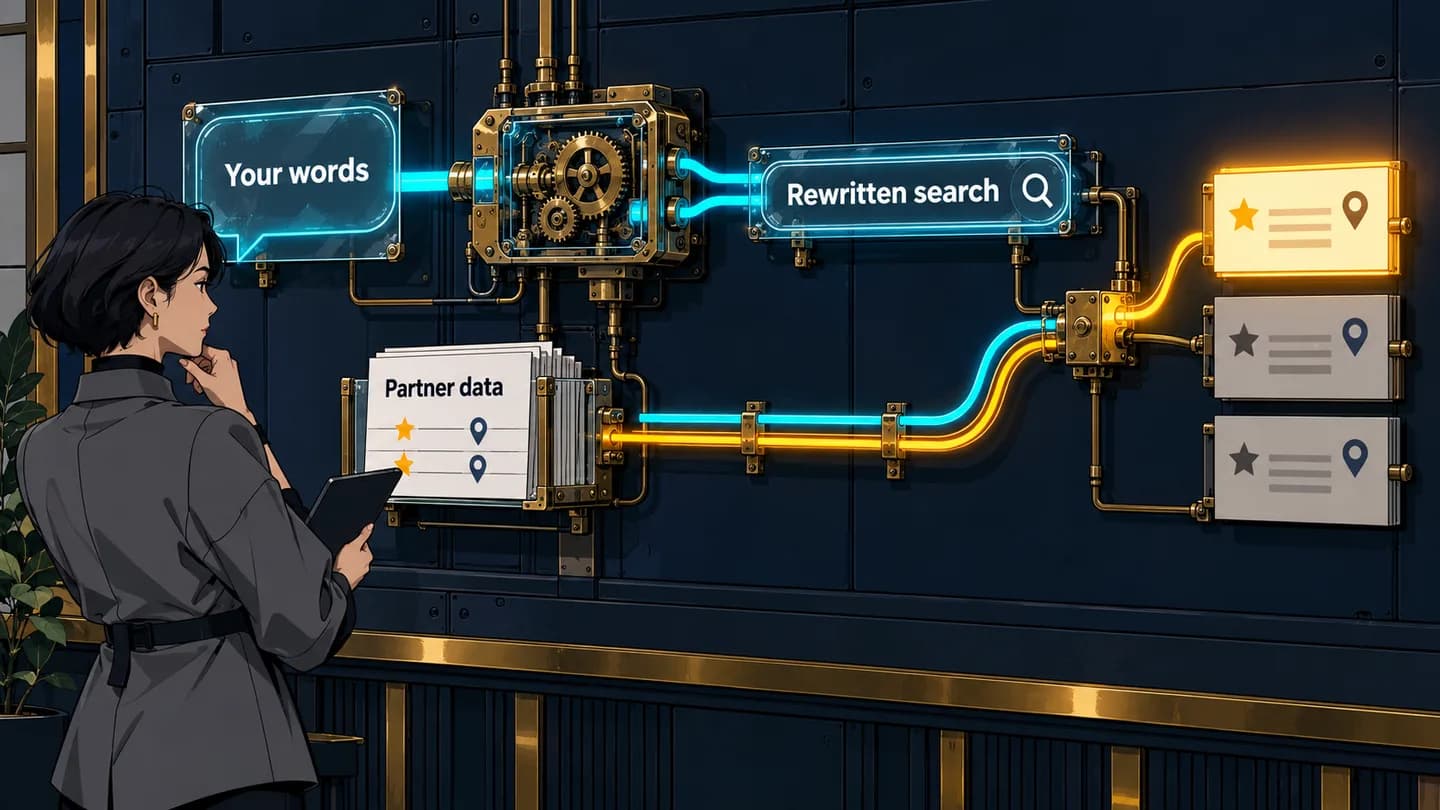
Notice the change from the person's question to the targeted search, then the addition of partner data before businesses are named. The original wording is only the starting point.
For a company with 10 to 200 people, the practical implication is a question of matching the service, attribute and location a search may contain. If a restaurant serves vegan food in San Francisco, a page or listing that states those facts gives a search system something concrete to match. OpenAI does not say that exact wording guarantees a match or a recommendation.
The same help page says ChatGPT may share location with unnamed trusted third-party providers that supply local information, including nearby business listings. It does not identify the local listings provider. For restaurant reservations, ChatGPT may show availability from OpenTable, Resy or Yelp when a supported provider has information for the restaurant.
OpenAI also states an eligibility condition for a website to appear in ChatGPT search answers: allow OAI-SearchBot and ensure the host or content delivery network permits traffic from OpenAI's published searchbot IP addresses. That condition concerns the site as a search source. Being eligible does not mean the business will be named in an answer.
OpenAI's shopping page describes product selection, not local ranking
OpenAI's shopping documentation lists three inputs for choosing products: structured metadata and other third-party content, model responses generated before new search results are considered, and OpenAI's safety standards and product policies. The second input means the model's response before a fresh search is part of the documented shopping process.
Applying that statement to local business recommendations is an inference. OpenAI does not say on the shopping page that the same input decides which local company to name, and it does not say how much any shopping input weighs. A confident claim that prior model knowledge determines a local recommendation would need evidence the page does not provide.
The shopping page gives a separate merchant ranking statement. OpenAI says merchants are ranked using factors such as availability, price, quality, and whether the merchant is the maker or primary seller. That is more specific than the search help page's “multiple factors,” but it describes merchants selling an item, not every local service business.
For Shopify merchants, OpenAI says product data is already integrated through Shopify Catalog and individual merchants do not need additional work for that integration. For a company selling products, the implication is that the catalog is a published route by which product information can reach ChatGPT. The documentation does not promise that every catalog item will be selected.
OpenAI says shopping review summaries draw on public websites and that reviews and ratings are “not verified by OpenAI.” A generated label such as “Budget-friendly” may reflect what reviewers frequently say about value. A review summary is therefore a description generated from source material, with the source material's accuracy still needing consideration.
The OpenAI crawler documentation adds a boundary to the search eligibility rule. Sites that opt out of OAI-SearchBot will not be shown in ChatGPT search answers, although they can still appear as navigational links. OpenAI says its systems can take about 24 hours to adjust after a robots.txt change, so an immediate check may not show the change yet.
Yelp's shareholder letters document a paid local data input
Yelp's 12 February 2026 shareholder letter says the company had recently signed an agreement with OpenAI. The 6 August 2026 letter gives the more useful operational detail: Yelp ratings and reviews had recently begun powering ChatGPT's local experience “in relevant categories.”
Yelp does not list those categories in the letter. It also says a Request-a-Quote integration with ChatGPT is coming. The documents establish a paid data relationship and identify ratings and reviews as inputs; they do not disclose a formula for choosing a business or the influence of an individual review.
The August letter also reports a study Yelp commissioned. For US home services discovery platforms in the fourth quarter of 2025, the study counted 512.7 thousand organic Yelp citations across ChatGPT, Gemini, Perplexity and Google AI Mode, 3.4 times the next platform in the comparison. Citations were counted whether or not someone clicked the link.
That count describes citations to Yelp across four named systems and a defined market. It does not tell you how often ChatGPT recommended a particular Yelp business, how much Yelp's licensed data contributed to an answer, or whether the same pattern applies outside the study's scope. The distinction between a cited platform and a named business changes what the number can prove.
For a company in a category where Yelp has a relevant record, the implication is still concrete: a review platform can be a direct data supplier, not simply a page an assistant happens to find. Whether a specific category feeds ChatGPT remains unpublished. I would treat the Yelp record as a source to inspect because Yelp identifies ratings and reviews as data supplied to ChatGPT, while keeping any claim about its ranking weight off the table.
Google's guide and Business Profile pages describe a different source system
Google's generative AI optimization guide says its generative AI features are rooted in its core Search ranking and quality systems. The same guide says Merchant Center feeds and Business Profiles can help products and services appear in AI responses and other Google Search results.
That connection is useful for a company deciding how to organize its work: Google's published starting point is its existing Search system, even though an AI response can draw on multiple searches and sources. The separate question of whether AI visibility needs its own budget belongs in the GEO versus SEO budget decision.
Google also says its generative AI features can show what is being said about products and services across the web, including in forums, videos and blogs. Its warning is specific: seeking inauthentic mentions is less useful than it may seem. A count of manufactured mentions is not a published ranking rule.
A Business Profile is not populated exclusively by its owner. Google's profile sourcing page says profile information is compiled from four kinds of source: public information such as a crawled official website, licensed third-party data, contributions from users and owners, and information based on Google's own interactions with a place or business.
For a company with several people responsible for its website and listings, that source mix creates a practical distinction. The owner can supply information, but Google can also encounter a different address, service description or other detail elsewhere. The published source list supports checking whether those records agree; it does not say how Google resolves every conflict.
Google's local ranking page says local results are mainly based on relevance, distance and popularity, and its sections discuss relevance, distance and prominence. Google says prominence can include links to the business and the number of reviews, with more reviews and positive ratings potentially helping local ranking.
That page describes Maps and Search results; Google does not document whether those same factors decide AI Mode's local answers. The page says nothing about review counts in AI answers. Google's AI guide supports keeping Business Profile information current, while leaving the selection formula for a named local business undisclosed.
Perplexity's research post separates its index from partner data
Perplexity's Search API research post says its index tracks more than 200 billion unique URLs. It says the system keeps some documents readily available for search, including documents from “authoritative domains” and documents about undercovered topics.
The scale describes the index, not the number of businesses Perplexity can recommend or a guarantee that a particular page is available for a particular answer. The statement about authoritative domains explains one priority for keeping documents available; it does not define how Perplexity chooses the business named in a local response.
Perplexity describes searching its index and reranking candidate documents; the full procedure for getting a page cited is in the AI search and answer engine guide. Its crawler documentation says PerplexityBot is designed to surface and link websites in Perplexity search results.
Partner data supplies another route into an answer. A Tripadvisor press release dated 10 January 2025 says Perplexity draws on Tripadvisor reviews and contributions, generated summaries, and Viator experiences. The release describes the collaboration without explaining how Perplexity selects one business over another.
A March 2024 report from Maginative also reported that Perplexity integrated Yelp business data, including reviews, photos and maps, into local answers. That is a reported integration, not a selection rule published by Perplexity. For a travel or local company, the implication is that the assistant may encounter business information through a partner as well as through its web index; the relative weight of those routes is unknown.
The published source map shows different inputs for each assistant
The published source map separates a vendor's available inputs from its stated selection rules. The entries identify what the documents describe; they do not show which input was used for a particular answer.
| Input | ChatGPT | Google AI Overviews and AI Mode | Perplexity |
|---|---|---|---|
| Web index | Search partners; OpenAI links Microsoft and Shopify privacy policies. OAI-SearchBot crawls sites for search. | Google Search index and core Search ranking systems. | Its own index, tracking more than 200 billion URLs. |
| Business data | Yelp ratings and reviews in relevant categories; unnamed trusted third-party providers for local listings. | Business Profile information from public web content, licensed data, users and owners, and Google's interactions with places. | Tripadvisor travel data; Yelp business data reported by Maginative. |
| Commerce data | Shopify Catalog and other product metadata. | Merchant Center feeds. | Not published. |
| Bookings | OpenTable, Resy or Yelp availability for supported restaurants. | Not published in the cited documents. | Not published in the cited documents. |
| Stated ranking rule | Search uses multiple factors and placement is not guaranteed; shopping merchants have separately stated factors. | AI features use core Search ranking systems. Google's local Maps and Search page names relevance, distance and prominence. | The index uses ranking and keeps documents from authoritative domains readily available; a business selection rule is not published. |
| Paying for placement | OpenAI says ads do not influence answers and shopping results are selected independently. | Google says there is no way to pay for a better local ranking on Maps and Search. | Not published. |
The map also explains why the same competitor can appear in one assistant and be absent from another. The vendors describe different indexes, different partner data and different selection statements. Without the underlying result and ranking information, those differences are possible explanations, not proof of why a particular competitor was named.
Can a business pay to be recommended in ChatGPT?
OpenAI says a business cannot influence ChatGPT's answers by buying an ad. Its help page on ads says ads run on separate systems and advertisers cannot shape, rank or alter responses; these are OpenAI's statements and are not independently audited in the cited material.
OpenAI makes a separate claim for shopping: product results are selected independently and are not influenced by OpenAI partnerships. That statement should not be confused with a claim that partner data is absent from the process. OpenAI lists third-party metadata as an input and identifies Shopify Catalog as a source of product data.
Google's statement is narrower in the documents considered here: its local ranking page says there is no way to request or pay for a better local ranking on Google. That is Google's own statement about local ranking, not an independent audit or a published formula for AI Mode business recommendations.
For a buyer assessing a proposed placement, the distinction is whether the seller can point to a documented advertising surface or is promising an organic recommendation. A vendor's data partnership, an ad and a named business in an answer are different things. The published statements do not support a promise that paying an advertiser or intermediary will buy an organic recommendation.
What nobody has published
The published documents leave the weights and several local selection decisions unknown. Those gaps limit how confidently anyone can explain a competitor's appearance or predict the effect of a change.
The documents do not disclose the weight of each factor at any of the three vendors, the identity of ChatGPT's local listings provider, or which Yelp categories feed ChatGPT. They also do not say whether review counts feed AI Mode local answers or how Perplexity chooses a business to name.
My view is that the most useful first check is whether the records the vendors identify can be accessed and describe the company accurately. That check has a clear reason: the documents name crawlers, profiles and partner data, while withholding the weights that would justify a more precise ranking recipe. Iron Goo's AI visibility work starts by mapping which sources describe a company and whether their accounts agree.
Use these observable checks to decide what needs attention:
- Your
robots.txtpermits OAI-SearchBot and PerplexityBot, and your site infrastructure allows the relevant crawler traffic. - Your Yelp listing exists in the category a buyer would ask for, without assuming Yelp has disclosed which categories feed ChatGPT.
- Your Business Profile and website state the service and city in words a rewritten query could contain.
- If you sell products, a Shopify Catalog or Merchant Center feed exists for the applicable platform.
These checks show whether the named inputs exist; they do not guarantee placement. To see what assistants currently say about your own company, use the separate business visibility test.

Put your next steps in order
Build on what you have just read with a free ebook on semantic SEO and AI visibility. Get worked examples, decision rules, checklists and a do-this-week action in every chapter, plus a six-week plan for your site.