
AI Overview Statistics: The Numbers That Matter
Table of contents
Google AI Overviews reach an enormous audience, but they do not appear on every search. Sundar Pichai said in Google's investor presentation on 3 June 2026: “AI Overviews now have over 2.5 billion users each month.” Google did not publish a method for that count.
The most useful AI overview statistics answer a different question: how often does a summary appear for the searches your buyers actually make? There is no single AI Overview rate. An academic measurement found summaries on 13.7% of trending queries overall, but on 64.7% of question-form queries.
An AI Overview is a generated summary with several citations on the normal results page; AI Mode is a separate conversational tab, while a featured snippet extracts a passage from one page. For a company with 10 to 200 people, the distinction matters when someone checks a buyer query: record the result type before comparing counts.
These numbers measure different things: a query form, the position of a cited source, an experimental change in clicks, and coverage on a selected keyword panel. A company deciding what to monitor should keep those denominators beside the percentages.
How often do AI Overviews appear?
AI Overviews appeared for 13.7% of searches run in one trending-query measurement and 18% of searches in a separate panel of real users. Neither figure is a universal rate: the samples, dates and units differ.
| Source | Sample | Dates | Share of what | Figure |
|---|---|---|---|---|
| Xu, Iqbal and Montgomery, academic measurement study | 55,393 US Google Trends queries, run by a Chrome crawler with a fresh, cookie-free browser profile in Northern Virginia | 13 March to 21 April 2026 | Searches run | 13.7% overall; 64.7% of question-form queries |
| Pew Research Center | 68,879 searches by 900 US adults, re-run in April | March 2025 browsing | Real searches in the panel | 18% overall; 60% with question words; 8% of one- or two-word searches |
| Semrush AI Overviews study | More than 10 million keywords from the Semrush database; country and device not stated | January to November 2025 | Keywords | 6.49% in January, 24.61% in July and 15.69% in November |
| Semrush commercial-modifier study | Fixed panel of 400 US desktop keywords | September 2025 to August 2026 | Keywords and, separately, their search volume | 88% of keywords; 97.08% by search volume in August |
Check the sample and what the percentage is a share of before comparing any two AI Overview numbers. The Semrush database figures, for example, count keywords rather than searches; a frequently searched keyword and a rarely searched keyword each count once. The commercial panel's volume-weighted figure gives more weight to keywords with greater search volume, and its selection method was not described.
Query wording also changes the measurement. In the arXiv study, queries starting with “how” triggered an overview 84.3% of the time, and those starting with “why” did so 73.4% of the time. The Pew panel found summaries on 53% of searches with 10 or more words.
For a company publishing answers to customer questions, those figures make the “how” and “why” queries on its own site a sensible place to check whether Google is answering on the results page. They do not predict the rate for a particular industry or list of queries.
How many sources does an AI Overview cite?
AI Overviews in the arXiv study cited a median of eight references after the researchers expanded each summary. The mean was 8.1, with a range from one to 32 references.
The Pew panel found that 88% of summaries cited at least three sources, while 1% cited one. Source counts depend on whether the summary has been expanded: in SE Ranking's one-time check of 100,013 keywords on 11 July 2024, the average was 2.5 links visible initially and 7.2 after expansion.
For a company checking whether its page appears, the practical distinction is visible citations versus the full expanded set. Record which one you counted, or a later check may look like a change in coverage when the viewing method changed. For a separate question, the research on how long a quotable answer should be examines answer length.
Cited sources extend beyond the first page
AI Overview citations include pages outside the first 10 result blocks. In Ahrefs' citation-position study, published on 2 March 2026 and covering 863,000 search results pages and 4 million AI Overview URLs, 37.9% of citations came from the first 10 blocks, down from about 76% in July 2025.
A result block is a broader unit than an organic link: an ad, featured snippet, People Also Ask box or video pack can each occupy a block. Counting organic links alone, Ahrefs found 37.1% of cited URLs in the top 10 positions, 26.2% at positions 11 through 100, and 36.7% outside the top 100.
The arXiv study used a different comparison and found that 29.8% of cited domains were absent from the first-page results shown with the same query. A company without a page-one result is therefore not excluded from citations, although these figures do not tell you the probability that its particular page will be cited.
Citations were also less concentrated among the largest hostnames in that study. The top 100 hostnames received 57.1% of AI Overview citations, compared with 72.3% of first-page links. In the Pew panel, Wikipedia, YouTube and Reddit together accounted for 15% of summary sources.
Those are reasons to inspect the cited URLs on your own queries, including the domains outside the visible organic results. The guide to SEO for AI search and answer engines explains how AI search selects and cites pages. If your site ranks on Google but is missing from AI answers, the comparison of Google rankings and AI visibility addresses that gap.
Citation sets change from one day to the next
AI Overview citation sets can change even when the same query produces a summary on consecutive days. Across 17,867 adjacent-day pairs of the same query in the arXiv study, only 0.24% of pairs with an overview on both days had exactly the same cited URLs.
The mean Jaccard similarity was 0.157, a measure of overlap between the two days' URL sets. Our reading is that the average overlap was small; the number does not identify which company's citation will disappear or when.
A single screenshot is one observation, not a standing position. For a company checking a product comparison query, record the date and cited URLs, then repeat the search on another day before treating an appearance or absence as settled.
AI Overviews coincide with fewer clicks
AI Overviews are associated with lower click rates in observational studies, and one randomized experiment found fewer organic clicks when overviews were present. The studies use different samples and click measures.
The Pew panel clicked a traditional result on 8% of visits when a summary appeared, compared with 15% when one did not. A link inside the summary received a click on about 1% of visits to pages with a summary. For a company with 10 to 200 people, check the click-through rate for a service page's question queries where a summary appears.
Ahrefs' click-through-rate update, published on 4 February 2026, analyzed aggregated desktop Search Console data for 300,000 keywords. For keywords with AI Overviews, average position-one CTR fell from 0.073 in December 2023 to 0.016 in December 2025. For informational keywords without an AI Overview, it fell from 0.076 to 0.039 over the same period.
Ahrefs' reported 58% reduction compares the observed position-one CTR with a forecast based on the decline in the comparison group. The 58% is not the direct percentage change from 0.073 to 0.016. For a company that ranks first for an informational query, check whether its page's CTR has changed alongside its position.
Position 1, 1,000 monthly desktop impressions: No AI Overview average: 1,000 x 0.039 = 39 clicks AI Overview average: 1,000 x 0.016 = 16 clicks
The example uses the December 2025 Ahrefs averages for an informational query. Our arithmetic on this hypothetical example gives a gap of 23 clicks per 1,000 monthly desktop impressions.
In a randomized field experiment reported by Agarwal and Sen, over 1,000 US users searched for two weeks in early 2026 with either normal Google Search or AI Overviews removed in real time. The authors reported 39.8% fewer organic clicks to third-party sites with overviews, a 34.5% increase in searches with no link clicked, and citations accounting for about 8% of all clicks. The experiment provides a causal comparison within its setting; the observational studies describe associations across their samples. The research is a working paper and has not been peer reviewed.
For a company publishing an answer to a customer question, check clicks and impressions for that query in Search Console. Record whether an AI Overview appears when you search it.
Seer Interactive's analysis, published on 24 April 2026, examined client data for 53 brands and 5.47 million queries from January 2025 to February 2026. On informational queries, cited brands received about 120% more organic clicks per impression than brands not cited, yet 38% fewer than on queries without an AI Overview. Seer says it cannot claim causation: stronger brands may be more likely to be cited, and its client data is not a random sample. For a company with an informational page, check whether the overview cites the brand and record clicks per impression separately.
In August 2025 Google's Liz Reid wrote: "Overall, total organic click volume from Google Search to websites has been relatively stable year-over-year." She did not publish figures to support the claim. Google's aggregate statement and the studies of selected queries measure different things.
Buyer-query coverage changes the investment decision
Semrush's fixed commercial panel showed AI Overviews on 88% of its keywords in August 2026, up from 45.75% in September 2025, and 97.08% when weighted by search volume. The panel covered banking, ecommerce and software, using five buyer-query shapes: alternatives, best X for Y, pricing or cost, reviews, and brand versus brand. The “best X for Y” group reached 96.12%.
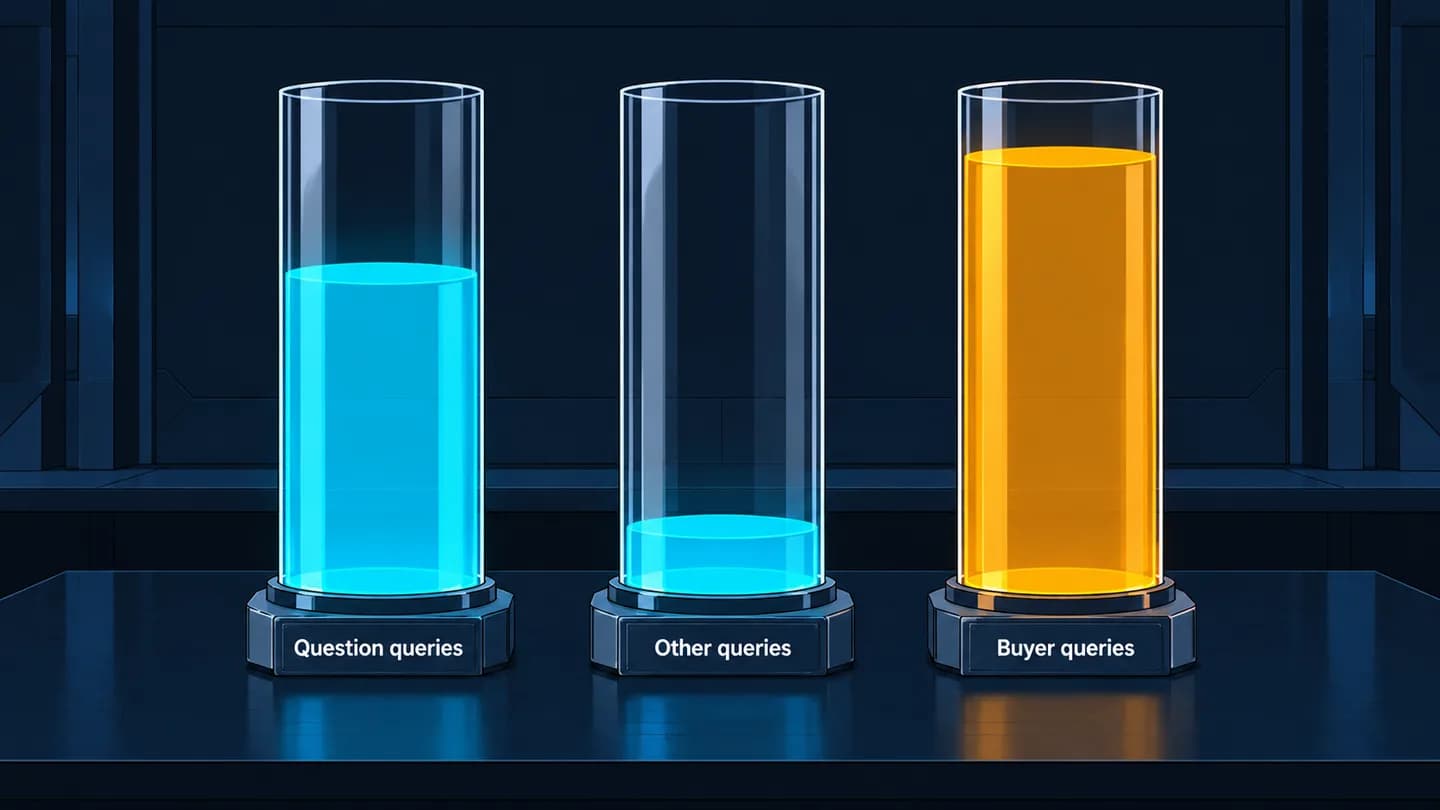
Question-form queries triggered summaries much more often than other queries in the academic study. Nearly all search volume on Semrush's selected commercial panel was covered; the panels measure different samples.
Those figures do not mean 88% of all commercial searches show an overview. They do mean a company should check its own pricing, comparison and review searches before assuming buyer queries are safe from summaries.
My opinion is that a company should measure and pursue citation on its own buyer queries before prioritizing informational traffic. The reason is that overviews appeared across a large share of Semrush's selected buyer-keyword panel, while Seer's informational-query data associates citation with more clicks per impression than non-citation; neither finding promises the same result for a particular buyer query. Iron Goo's AI search visibility service focuses on measuring and pursuing that visibility.
List your ten buyer queries across the five shapes, search them signed out on two different days, and record whether an AI Overview appears and whether it cites your company.
Put your next steps in order
Build on what you have just read with a free ebook on semantic SEO and AI visibility. Get worked examples, decision rules, checklists and a do-this-week action in every chapter, plus a six-week plan for your site.