
How to Rank for Near Me Searches: From 3-Pack to AI

Table of contents
Near me searches are on your checklist because an agency told you to add those words to page titles and build pages around them. Here is how to rank for near me searches: you do not need to rank for the words “near me.” Google uses the searcher's location and ranks local results mainly on relevance, distance and popularity; ChatGPT may rewrite the request as a service plus a city. Google's own example of a local search is simply “Italian restaurant.”
- 26 October 2010A patent describes location prominence
A Google patent describes ranking well-known places in an area, with factors including authoritative documents, references and reviews, rather than relying only on distance. A patent describes a method; it does not establish that Google uses it.
- 24 July 2014Pigeon enters the local search vocabulary
Search Engine Journal's recap dates an unannounced local change to around this day and reports improved location and distance parameters. The industry named it Pigeon; Google never confirmed that name.
- August 2015The local pack shrinks
As BrightLocal recorded it, Google's local pack went from seven businesses to three. Fewer visible positions made the choice among nearby businesses more consequential.
- 1 September 2016Possum favors proximity over a boundary
PPC Land's recap says the industry named the unconfirmed update Possum and reports that proximity replaced a hard city-boundary test. Businesses outside an administrative boundary could gain ground for searches within the city.
- 15 May 2018Google publishes near me behavior data
Google's mobile search data shows growth in U.S. mobile searches combining “near me” with purchase or time requirements. The figures compare July to December 2015 with July to December 2017.
- 23 July 2021Mueller separates location from page wording
Google's John Mueller said “near me” is not something specific on a business website and advised defining the location clearly on pages, according to Search Engine Journal's transcript of the session. Google can then apply a geographic distance algorithm.
- 30 November to 8 December 2021Google rebalances local factors
Google confirmed that its November local search update involved a rebalancing of factors; practitioners called it Vicinity, as the local SEO guide explains.
- 14 May 2024AI Overviews roll out in the United States
Google announced the U.S. rollout of AI Overviews and gave a local example involving studios, introductory offers and walking time.
- 31 October 2024ChatGPT search launches with maps
ChatGPT search launched with maps among its visual categories and used third-party search providers and partner content.
- 20 May 2025AI Mode reaches the United States
Google began rolling out AI Mode in the United States and identified local appointments as an agentic task.
- Mid-June to mid-July 2025Popularity replaces prominence in the opening line
- 5 November 2025Gemini arrives in Google Maps
Gemini features in Maps brought conversational navigation and questions about places. Google cited information about 250 million places at the time.
- 12 March 2026Ask Maps adds conversational place search
Google introduced Ask Maps, which analyzes information from more than 300 million places and personalizes results using places a person searched for or saved.
- 6 August 2026Yelp data reaches ChatGPT local answers
Yelp said its ratings and reviews had recently begun powering ChatGPT's local experience in relevant categories. Yelp did not list those categories in the letter.
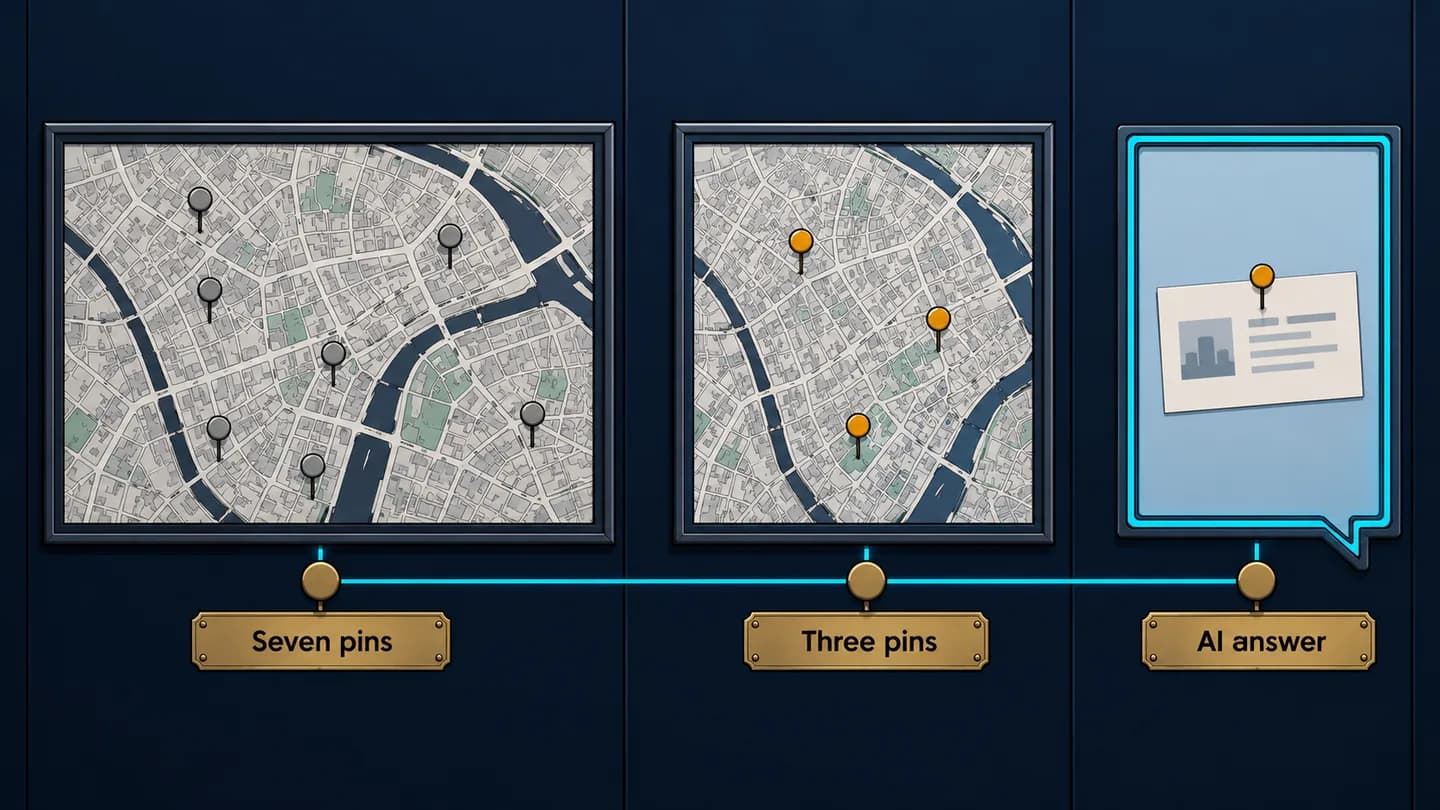
The visible answer has narrowed from a seven-business pack to three. An agency later reported AI Local Packs that often show one or two businesses.
Google's near me data measures specific search subsets
Google's near me data measures growth in particular kinds of mobile searches, not the share of searches that contained the phrase. The comparison covers U.S. mobile searches from July through December 2015 against the same months in 2017.
Searches containing “near me” and a version of “can I buy” or “to buy” grew by over 500%. Searches for “near me today” or “near me tonight” grew by over 900%, “near me now” grew by over 150%, and searches combining “open,” “now” and “near me” grew by over 200%.
Those are growth rates for subsets of searches, using data that is nine to eleven years old by our arithmetic. A 500% increase in one subset does not tell you what percentage of all searches it represented.
Google also observed that smartphone users were dropping location qualifiers such as ZIP codes in 2017 because they expected their devices to make results local. The examples show the searcher's requirements becoming more specific: an item to buy, a place open now or somewhere to visit tonight. In our reading, the phrase described what the searcher wanted, rather than a keyword the business needed to rank for.
Do you need the words near me on your website?
You do not need the words “near me” on your website to rank for near me searches. In Google's 23 July 2021 office-hours, as transcribed by Search Engine Journal on 3 August 2021, John Mueller said: “it's not that you need to rank for near me because near me is essentially, like... global. It's not something specific on your website.”
Mueller's instruction was to define your location clearly on your pages so Google can associate the location with the page and match it to the user through a “geographic distance algorithm.” A page can say what service a business provides and where it provides it without treating “near me” as a place name.
In her 22 January 2025 Sterling Sky article, “How to Rank for Near Me Searches on Google,” Joy Hawkins recommends adding phrases such as “near me” or “near you” to website titles, headers and URLs. She says Google treats the phrases as interchangeable and shows screenshots of organic results, though the article publishes no sample size or method. Hawkins says her team has seen the tactic affect only organic search rankings, not Google Maps or local pack rankings.
In our opinion, either phrase is harmless in one title where it reads naturally, but it is useless as a map pack tactic and does not justify building pages around it. The reason is the distinction in the evidence: Hawkins reports an organic result while saying she has seen no effect on the local pack.
Google's wording changed from prominence to popularity
Google's local ranking help page changed its opening description from prominence to popularity between mid-June and mid-July 2025, going by Wayback Machine snapshots. The April 2016 Wayback Machine snapshot said local results were “based primarily on relevance, distance and prominence,” and the 14 June 2025 snapshot still used prominence.
By the 10 July 2025 snapshot, the opening said local results were “mainly based on relevance, distance, and popularity.” Google's help page still opened that way when we checked it on 1 November 2026, while its section heading still said Prominence. We found no announcement of a ranking change, so treating the word swap as evidence of one would be speculation.
The page describes local results on Google Maps and Search. It says prominence is based partly on how many websites link to a business and how many reviews it has; the evidence about reviews and mentions deserves its own discussion. Google also states: “There's no way to request or pay for a better local ranking on Google.”
Relevance describes how well a business matches the search, while distance concerns how far the business is from the searcher. If a customer does not share a location, Google says it uses what it knows about that location. A business can make its service clear, but it cannot move the searcher closer.
AI systems resolve location before matching local businesses
AI systems can resolve a near me request through a location lookup or a rewritten query before matching a business. The vendors do not publish every step for every product, so the details differ by system.
OpenAI's search documentation gives a concrete example: “What are some good restaurants near me?” may become “top restaurants San Francisco” when ChatGPT determines the user is in that area from an IP address. OpenAI says the IP address itself is not shared with third-party search providers, and device location sharing is optional and off by default.
Yelp's August 2026 letter adds another part of that path: its ratings and reviews had recently begun powering ChatGPT's local experience in relevant categories. The AI recommendations source review examines the vendor documents in full.
Google's guidance on AI features in Search says AI responses can include local business information and that Business Profiles can contribute to visibility in those responses. Ask Maps draws on information about more than 300 million places, including reviews from more than 500 million contributors, and personalizes results using places a person has searched for or saved.
Agentic calling has a different use for the phrase. Google tells users to add “near me” or “nearby” to a product search so it can offer to call local stores about stock. That instruction is a trigger for the person searching; it is not an instruction to put the words on a store's website.
| System | What happens to “near me” | What the business is matched on |
|---|---|---|
| Google Maps and the local pack | Google uses the device location or what it knows about the searcher's location. | Business Profile relevance, distance and popularity, also described as prominence. |
| AI Mode and AI Overviews | The precise handling of the words is not published; Google says the features draw on core Search systems. | Business Profiles and web pages can contribute; weights are not published. |
| Ask Maps | The precise handling of the words is not published; results can reflect searched or saved places. | Place information and contributor reviews; selection weights are not published. |
| Agentic calling | Google asks users to add “near me” or “nearby” to a product search. | Google calls relevant businesses; its selection method is not published. |
| ChatGPT | ChatGPT may rewrite the request as a service plus a city inferred from IP location. | Search partners, unnamed listing providers and Yelp ratings and reviews in relevant categories; weights are not published. |
The number of businesses shown may also change with the answer format. A 21 September 2026 post on the Sterling Sky agency blog, citing Places Scout data, reported AI Local Packs on roughly 8% of keywords, often with one or two businesses, and 32% fewer unique businesses than traditional packs. The page publishes no method or sample, so those figures are a reported observation, not a forecast for your searches.
The record is the part a business can maintain
Our rule is that “near me” is a location signal supplied by the searcher's device or other available location information; the business maintains the record a system reads. Name your service in plain words on your profile and pages, and state your place plainly in text. Distance from any particular searcher is outside your control.
Keep the Business Profile current. Google's Business Profile help says owner edits usually take up to 10 minutes to review, although review can sometimes take up to 30 days. After Google notifies you of certain suggested edits, you have four days to accept or reject them; if you do not respond, Google may publish an update supported by public information, including your website. If a profile or AI answer already carries a wrong fact, follow the steps for correcting an AI answer.
Use the local SEO guide for the full procedure. Iron Goo's SEO service keeps the profile, website and licensed listings consistent about the services you provide and the places you serve.

Put your next steps in order
Build on what you have just read with a free ebook on semantic SEO and AI visibility. Get worked examples, decision rules, checklists and a do-this-week action in every chapter, plus a six-week plan for your site.