
How to Get Backlinks for an Established Company

Table of contents
How to get backlinks: claim the links your existing relationships have already earned, publish one piece of original data, then pitch that data to local and trade press, in that order. A backlink is a link from another website to yours, and an earned link gives the other site a reason to include it for its readers.
Google's SEO Starter Guide says links from other sites happen naturally over time and that promoting your site can encourage people to discover your content. The order gives that promotion something to point to: existing relationships need no new asset, while a journalist needs a story. This sequence earns links without buying them; backlink packages are a separate decision.
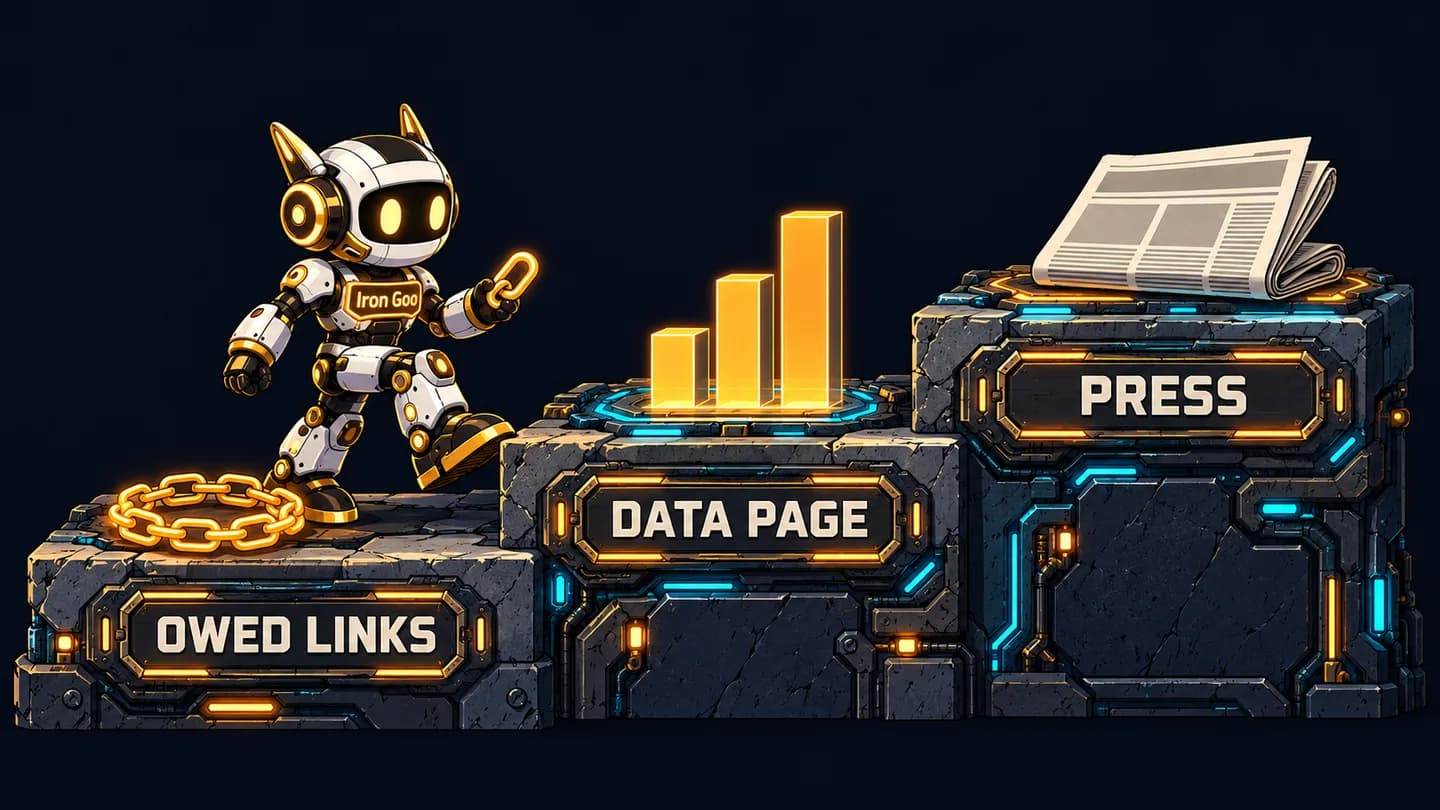
Start with existing relationships at the base, build a data page next, and pitch the resulting story to the press last. Each layer gives the next one a firmer starting point.
The company in this example is hypothetical: a 60-person commercial HVAC installer serving one metro area. It has 12 equipment suppliers or manufacturers, two software or service partners, three associations (a regional contractors' association, a chamber of commerce and a trade body), two local sponsorships, past press coverage that named the company, and about 3,000 service tickets from the last three years.
Step 0: export the links you can already see
A Search Console Links report gives the hypothetical company a starting sample of sites and pages to check. An absent link is a reason to inspect the source page, not proof that the link does not exist.
The hours, calendar periods, pitch threshold and example arithmetic throughout are our planning assumptions for this hypothetical company, not measured industry averages.
Precondition: The company has verified its site in Search Console.
Time: One hour of staff time, completed in one day.
Done when: The Links report export exists and a relationship sheet has been started.
Open the Search Console Links report and inspect Top linking sites and Top linked pages. The report tables show up to 1,000 rows; Export from the landing page can provide up to 100,000 rows, including Latest links, sorted by discovery date. The report does not indicate whether a link carries a nofollow attribute, and a reported link may since have been removed.
Start a sheet with the organization or publication, its relevant page, the company's matching page, link status, contact and request date. Add known suppliers, partners, associations and sponsorships even when absent from the export.
Step 1: claim links from existing relationships
Existing supplier, partner and member pages give the HVAC installer places to request a link without creating a new asset. Start with pages that already serve customers or members, then work toward mentions and old URLs that need individual checks.
Precondition: The baseline sheet exists, and the site has a relevant brand, product, service or area page for each appropriate listing.
Time: Eight to 12 staff hours over three to six weeks, including time waiting for replies.
Done when: Every relationship row is marked linked, listed without a link and asked, declined, or no page exists; check Latest links for newly discovered links.
Work through the sources in this order:
- Suppliers and manufacturers. Check each of the 12 for a dealer, stockist or certified-installer page. If the installer is listed without a link, ask the owner to link its entry to the relevant page on the company site.
- Partners. Check the two software or service partners for customer-facing partner or integration pages. A page that explains a real relationship to customers has a different purpose from a page made solely to swap links.
- Associations. Check the regional association, chamber and trade body for existing member entries. Confirm that each entry, where links are offered, points to a current page.
- Sponsorships. Check the two local sponsorship pages for the agreed listing. Accept a link qualified as sponsored or nofollow, and judge the sponsorship link by referral traffic rather than assumed ranking credit.
- Unlinked mentions. Find the past articles that name the company, confirm whether the name links, and make one polite request with the exact page you would like linked. A company mention without a link is a separate subject from the request to add one.
- Old link targets. Check the URLs in Top linked pages for errors. If an old URL returns a 404, put a 301 redirect on your own server to the closest current page; no outreach is needed.
An entry can be correct without a link. Record a decline and move on; a relationship sheet is useful because it makes those outcomes visible, not because every row turns green.
Google's link spam policy, updated 28 August 2026, names these examples:
- "Exchanging goods or services for links"
- "Sending someone a product in exchange for them writing about it and including a link"
- "Excessive link exchanges ("Link to me and I'll link to you") or partner pages exclusively for the sake of cross-linking"
- "Requiring a link as part of a Terms of Service, contract, or similar arrangement without allowing a third-party content owner the choice of qualifying the outbound link"
Ask where a listing already exists for customers. Never tie the link to an order, discount or contract, and accept rel="sponsored" or rel="nofollow". Google permits advertising and sponsorship links when qualified with either attribute.
The same policy names links with optimized anchor text in articles, guest posts or press releases distributed on other sites. A useful customer listing and an editorial decision give the other site a reason to link; a transaction made conditional on the link crosses a different line.
Step 2: publish one page of original data
An original data page gives a journalist something specific to examine and potentially cite. The HVAC installer can use its service tickets only if the records support a defensible finding and the company has permission to publish aggregates.
Precondition: The company holds a dataset large enough to split, has permission to publish aggregates, and has someone who can write the method.
Time: Twenty to 40 staff hours over three to six weeks.
Done when: The page is live with its method, sample size, date range, one headline figure and one chart, and a pitch summary under 200 words is ready.
The hypothetical dataset has about 3,000 tickets across three years, with fault type, equipment age and time to repair. Before choosing a headline, check how consistently those fields were recorded and whether each group is large enough to describe without exposing a customer's information. If the records cannot support a comparison, say so and choose a narrower finding.
Publish the actual sample size and dates used, explain which tickets were included, define how repair time was calculated, and show one chart that follows from the data. A headline figure could describe a real difference between equipment-age groups, provided the records support it. The company should not invent a percentage to make the page more pitchable.
In Muck Rack's State of Journalism survey, 40% of respondents wanted original data or research offered with a pitch, while 71% said they immediately disregard or delete pitches that are overly promotional or advertorial. Muck Rack surveyed 1,044 journalists from 30 January to 2 March 2026 and analyzed 897 responses, mostly from US-based journalists.
Real data is also a policy boundary. Google's spam policy names “Creating low-value content primarily for the purposes of manipulating linking and ranking signals”; a made-up survey built to attract links fits that description. A method a reader can inspect gives the finding a use beyond the request for coverage.
Step 3: pitch the data to local and trade press
Local and trade press pitches offer the HVAC installer's data to readers affected by the finding. A local reporter may cover commercial buildings in the metro area; a trade reporter may cover the equipment.
Precondition: The data page is live, a named spokesperson will take calls, and 20 to 40 journalists have been selected by beat.
Time: Two to three staff hours a week over eight to 12 weeks.
Done when: The first editorial link or citation appears. If 20 or more pitches receive no reply, change the angle before sending more.
Check each journalist's recent coverage. Lead with a finding relevant to the outlet's readers, link to the method and chart, and name an available spokesperson.
Muck Rack's 2026 survey found that 70% wanted clear relevance to their beat and 88% deleted pitches irrelevant to their coverage. Asked what makes a pitch relevant to an audience, 78% chose a direct effect on the audience's community, and 58% wanted interview access to relevant sources. Those answers support starting with a local or trade angle.
The report's “The perfect pitch” page summarizes eight years of Muck Rack surveys: 62% preferred one-to-one email, 78% wanted pitches before noon, and 69% preferred fewer than 200 words. Send one follow-up: 50% said one was ideal, and 51% said it should arrive within three to seven days.
HARO is not an option: Cision discontinued Connectively, formerly HARO, on 9 December 2024. Build a list of reporters whose beats fit the finding.
| Step | Precondition | Staff time | Calendar | Done-signal |
|---|---|---|---|---|
| 0. Baseline | Verified Search Console | 1 hour | 1 day | Export and relationship sheet exist |
| 1. Existing links | Sheet and matching site pages | 8 to 12 hours | 3 to 6 weeks | Every relationship has a status; check Latest links for discoveries |
| 2. Data page | Usable owned dataset, permission and method writer | 20 to 40 hours | 3 to 6 weeks | Page and method live; short pitch summary ready |
| 3. Press | Data page, spokesperson and beat-matched list | 2 to 3 hours a week | 8 to 12 weeks | First editorial link or citation; change angle after 20 unanswered pitches |
How many backlinks do you need, and how long does earning them take?
A company does not need a universal number of backlinks, and earning links through press outreach can take weeks. Plan around relevant opportunities and track the results.
Backlinko's study with Pitchbox, last updated 16 April 2019, found that 8.5% of 12 million outreach emails received any response. A response is not a link. An Ahrefs author reported earning 19 backlinks from 111 emails and wrote that a rate above 10% is usually considered amazing; his account was updated 8 March 2024.
For the hypothetical installer, 30 pitches multiplied by an assumed 10% coverage rate yields three pieces of coverage. That is our planning arithmetic, not a forecast, and coverage may cite the company without linking to it.
At SERP Conf in Bulgaria on 19 April 2024, Gary Illyes said Google needs very few links to rank pages and has made links less important over the years, according to Patrick Stox's account as reported by Search Engine Journal. Google's ranking systems guide still says PageRank is part of its core ranking systems. Our working target is a few independent, relevant editorial links from real businesses and publications, guided by the opportunities available to your company.
Why the order protects the press opportunity
The sequence starts with existing relationships because those people already know the company. A data page then gives journalists a verifiable finding to link to, while 71% of surveyed journalists delete overly promotional pitches.
Muck Rack also found that 46% delete pitches sent repeatedly without a response. Our inference is that pitching reporters too early can use up the attention a data story needs later, especially if the first message gave them no reason to reply.
Earned press links will usually land on the data page. Use the internal linking architecture guide to connect it to relevant service pages, or ask Iron Goo's SEO service to build the page and route its earned links.
Export the Links report and start the relationship sheet this week. Add the organizations you already know.

Put your next steps in order
Build on what you have just read with a free ebook on semantic SEO and AI visibility. Get worked examples, decision rules, checklists and a do-this-week action in every chapter, plus a six-week plan for your site.