
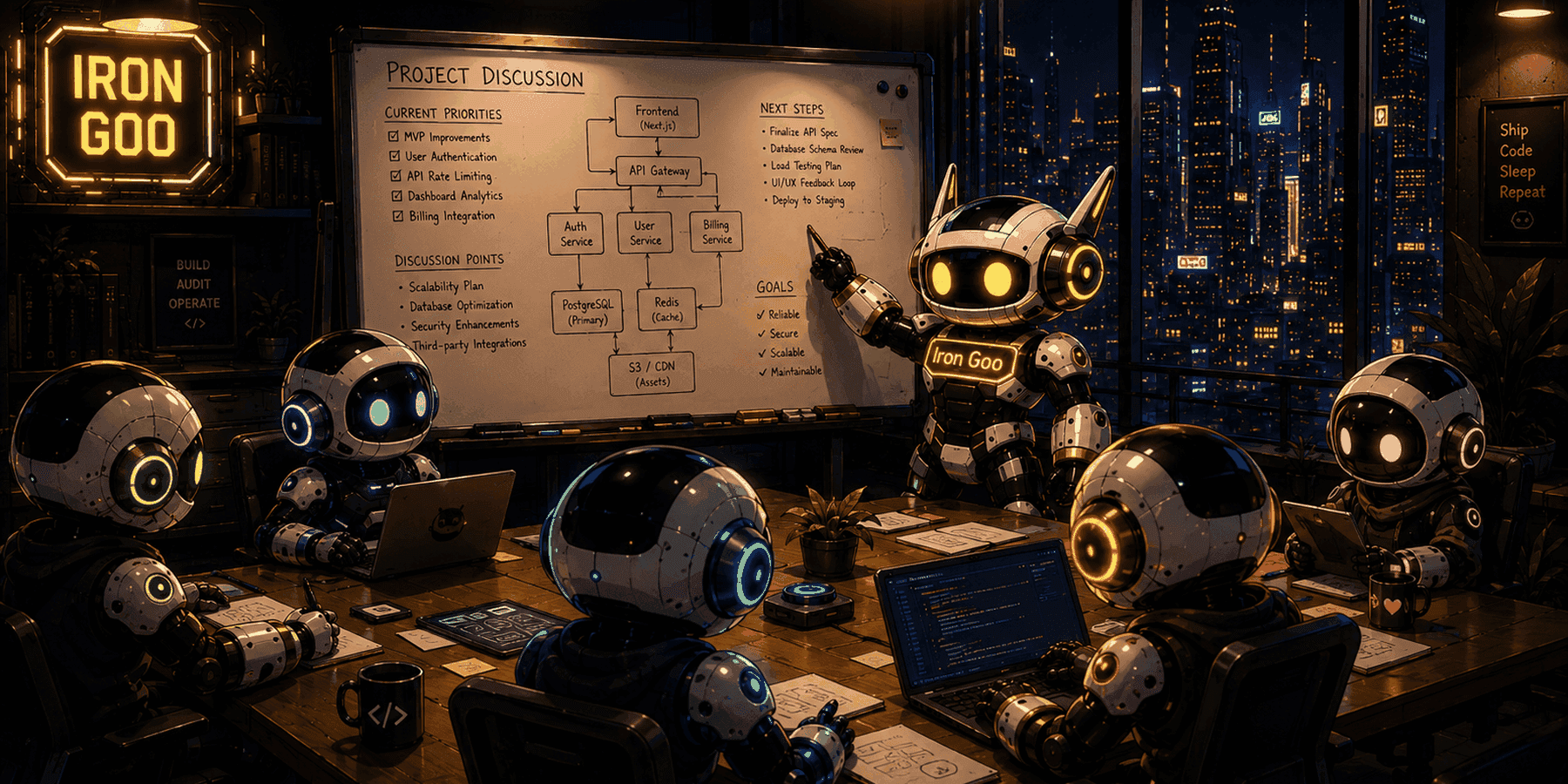
Run AI in your business, every day
Chatbots on the front desk that handle the boring 80% of inbound, plus a 24/7 AI operations layer (Claude Code, OpenClaw) keeping the whole stack alive while you sleep. Two halves of the same job: AI in your business, every day.
There are two halves to running AI in a real business
The first half is customer-facing: a chatbot on your front desk. The second half is internal: agentic clients running your operations work. Most agencies sell one or the other. We run both because the same business needs both, and they share more plumbing than people assume.
Front desk first. Most owners we talk to had a bad chatbot experience around 2017 to 2019. Scripted decision trees that pretended to help and then dumped the user back to email. The technology underneath has changed completely. The shape of a useful chatbot today is retrieval first: every time a customer asks something, the bot reads your real documents (help center, product specs, pricing page, past tickets) and writes its answer from what it found. It cites where the answer came from. It refuses cleanly when the answer is not in the source material. It hands off to a human for anything high-stakes, and it gets out of the way.
Done well, that handles the volume that wrecks small support teams: shipping, returns, hours, warranty coverage, scheduling. Done well, it also captures sales intent: a homebuilder we helped now gets twelve qualified leads a month from website chat, on a form that previously converted under one percent.

The internal half
Real AI operations is not a chatbot in your app with API keys. It is an agentic client (Claude Code from Anthropic, OpenClaw, OpenAI Codex) running on a controlled environment with shell access, version control, and a human supervisor. The same shape engineering teams already use. It deploys code. It reads logs and diagnoses incidents. It drafts customer responses. It updates documentation. It runs scheduled maintenance. It writes its own commits with a clear audit trail. What makes it safe is the written knowledge wiki underneath (runbooks, project memory, conventions) that the agent reads on every run.
We build both halves on the same plumbing: retrieval-grounded responses, a written knowledge layer, scoped credentials, audit logging on every action, and clear boundaries on what is automated and what is not. Anything that touches money, personnel, or contracts is human-decided. You can pull the keys at any time.
What you get
- A retrieval-grounded chatbot on your site (and optionally inside Slack, Intercom, or your existing helpdesk), with citations to the source it answered from.
- Refusal and escalation paths: when the bot does not know, it says so and routes to a human with the conversation context preserved. Sales-side capture: lead qualification, calendar booking, CRM handoff.
- Hallucination guardrails on the chatbot: out-of-scope detection, prompt injection defenses, logged audit trail for every conversation, admin view your team can use to update the knowledge base without touching code.
- Claude Code and OpenClaw configured against your stack for internal ops, with scoped credentials, controlled execution environment, and audit logging on every action.
- A written knowledge wiki: runbooks, project memory, conventions, common-task skills, kept in version control and reviewed by humans.
- Defined operations the agent runs daily (deploys, log review, monitoring response, scheduled jobs, content publishing) and a documented list of what it does not run (anything touching money, personnel, or contracts).
- On-call coverage: a human (us) reviewing the agent's overnight work each morning, plus monthly reports on chatbot deflection, escalation, and agent ops with what changed and what we are shipping next.
How we deliver this
Audit phase, two to three weeks. For the chatbot side, we read three months of your support tickets and map the top fifty inbound questions by volume. For the ops side, we sit with you and map the operations work that consumes your team's time. What gets deployed and how, what gets monitored, where on-call calls come from. We score each task as agent-suitable or not, and we are honest about the second category.
Build phase, six to ten weeks. Chatbot: knowledge prep, content gap fills, retrieval pipeline, shadow-mode testing against real conversations until the accuracy numbers are good enough to put live. Ops: agent environments set up, initial wiki written against your real systems, the first skills built (deploy, log review, content draft, incident triage), all run in shadow mode with a human verifying every action before any of it executes against your live stack.
Operate phase, ongoing. The chatbot answers customers. The agent runs the daily ops work. We review every audit log, add new skills as you find more tasks worth handing off, retire skills that turned out to need a human, and update the knowledge base on a weekly cadence. You see a monthly report. The exit plan is built in: the wiki, the configuration, and the audit history all transfer cleanly if you ever want to take this in-house or move to another partner.

Who it's for
This pays back hardest for businesses with real volume of repeat customer questions and real engineering operations: e-commerce with shipping and return queries, services with scheduling and pricing, software with onboarding and feature questions, plus weekly deploys, logs that need watching, customer comms that eat hours. If your team is answering the same support question fifty times a week and also asking who is on-call tonight, the math is easy.
It is also for owners weighing the choice of hiring an FTE engineer versus contracting a partner. Run the math against an agent-supervised setup before you sign an offer letter. We will be straight with you about where this beats hiring (24/7 coverage, never sick, perfect memory) and where hiring still wins (judgment calls, building rapport with your team, owning long-term architecture).
What Our Clients Say
“After we started working with Iron Goo's skilled and determined team, organic traffic helped us multiply both our sales and our revenue.”

“Thanks to Iron Goo, we reached a target we had called nearly impossible. We gained about 300,000 users in a short time and our revenue grew 2,500%.”

“Iron Goo is an agency that understands business instinctively. In 3 months they helped us succeed in a highly competitive industry.”

Ready to talk about operations?
Tell us where your business is and we'll send back a written assessment within two business days.
Talk to us